Family History and Roots
The Hart Family
My great-great-grandfather was hoeing corn down in the Green Cove area when he was conscripted — or volunteered, we're not entirely sure — for the Civil War. The family never heard from him again. That's where the record ends for him.
My great-grandfather was a Hart and he's the one who signed the agreement for the railroad to come through Green Cove. The Hart family operated a grist mill there, grinding corn and sawing lumber. A hurricane took it out about twenty years ago now. The millstones were moved to White's Mill in Abingdon after that.
Those millstones originally came from Chilhowie, Virginia, over in Smyth County — hauled by horse and wagon before the railroad ever got here. My female cousin still has the original invoice for them.
Maryland and the Return
At some point, James Hart and his son Isaiah sold their land at Green Cove — likely to William Buchanan — and moved north to Darlington, Maryland, where they bought a farm. My grandmother did not like it up there. The family came back and bought a hundred acres at Whitetop.
My grandfather started building the house that still stands up there — never finished it. Construction stopped in the late thirties or early forties when a man borrowed somewhere between two and four thousand dollars and never paid it back. He had promised to repay with land and a house comparable to McCann's Inn — my mother actually moved over there in anticipation of it — but the man reneged on the whole thing. The house was never finished past the downstairs and two bedrooms upstairs. That's the house I grew up in.
The Buchanan Connection
There's what people call "Buchanan's Inn" or the "Cannon House" — that was William and Mary Buchanan's family home. It was later given to their granddaughter, who converted it into a bed and breakfast.
My Uncle Bill was something of a one-man operation. He was the postmaster, the station agent, and the storekeeper at Green Cove all at the same time. The family also sold lunches to the train passengers when they came through. There's a yellow house near the Buchanan property that's been there as long as I can remember — my uncle lived there.
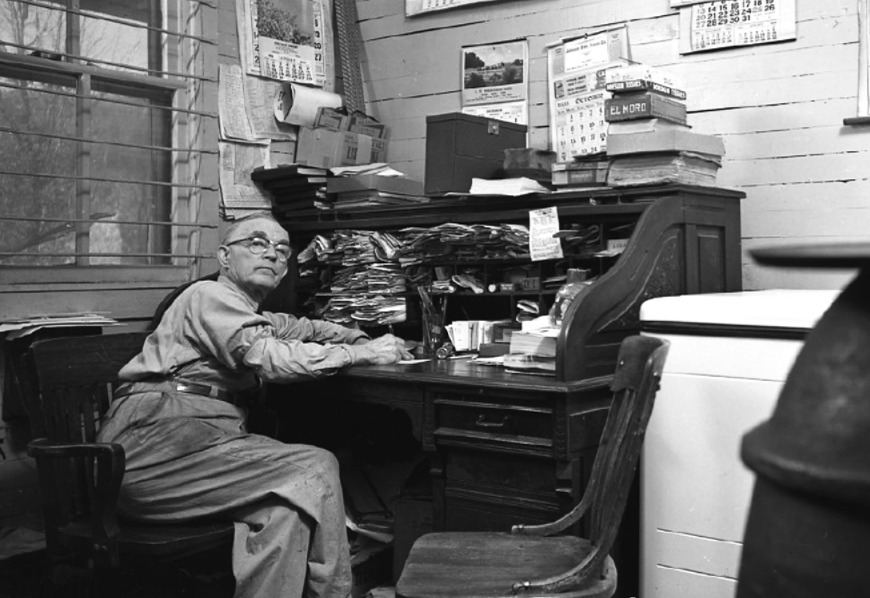
William Buchanan at his rolltop desk in Green Cove Station
(O. Winston Link's full collection of railroad photography together with interactive displays of his camera equipment, darkroom and artifacts from some of his images can be found at the O. Winston Link Museum located in Roanoke, Virginia. The Link Museum is the repository of all negatives, equipment, sounds, and images associated with Mr. Link's famous work documenting the last days of steam railroading and a vanishing way of life in America. For more information on Link and his photographs, visit www.roanokehistory.org. Photograph used with permission from the Link Museum.)
The Railroad — Operations and History
Route and Infrastructure
I used to ride from Whitetop station down to Green Cove station for seven cents — about the same as two eggs back then. I also rode to West Jefferson, North Carolina with my sister when I was around seven years old.
"There's nobody that would probably know — they're all deceased."— on the locations of the old spur lines
Whitetop was as far as the train came, and I remember there used to be a turnaround table right where the parking lot is now — long gone. There were Y-junctions over at West Jefferson and at Abingdon, for reversing direction.
The railroad tracked the Horse Creek grade all the way from the Damascus area down to Lansing, North Carolina. Parts of that route you can't even get to by road anymore. Spur lines branched off into the various hollows. Their exact locations are largely lost now.
Directly across from my house — and from my grandparents' unfinished house — is where the Hassinger Lumber Company spur used to run. The tracks and the trestle have both been removed. The section from Green Cove up to Whitetop was overseen by a man named Doggett and that's most likely where the settlement name "Dogtown" came from.
Daily Operations
The train ran on a very precise schedule. It blew its whistle about a mile out from each station in both directions, giving the postmaster time to get the mail down to the platform. My Uncle Bill handled the mail at Green Cove that way.
During the busiest timber years, I believe there were two passenger trains running per day. Cattle were shipped out by train — the livestock scales were at the gate near the Jamie Lee property. Gravel was still being unloaded at Whitetop into the 1950s, coming down a chute and elevator system onto trucks. Pulpwood and extract were also loaded out at Green Cove and Whitetop.
Between Green Cove and Whitetop, the train crew would sometimes throw candy out to the children along the tracks. I remember that.
Track Safety — Torpedoes
Workers would place small blasting caps on the rails — they called them "torpedoes" — clamped down with little lead brackets to warn the engineer when a crew was working ahead. They'd set them out one to two miles from the work site, loud enough to be heard over the engine. I saw them as a child. They were roughly quarter-sized, the lead bracket wrapped right around the rail.
Notable Incidents
There was a tourist excursion they called the "excursion train" — it jumped the tracks between Whitetop and Green Cove, near a place called "horseshoe bend," and dragged the derailed cars all the way to Whitetop before anyone even realized what had happened. Ties were cut. Everyone survived.
There was a boy — around ten or eleven — who was hoboing on Train No. 12 near the No. 12 trestle. He slipped and went under the train and lost his leg. He survived, left the area, and came back years later.
"One of the sharpest men I ever knew."— on the boy who lost his leg on Train No. 12; he worked with Scott for 13 years
Decline of the Railroad
"The foundation was pulled out."— on why the railroad ended; timber exhausted, trucks replaced trains, roads improved
Each function the train served found some other way to get done. Timber was exhausted by the 1950s. Trucks took over the gravel and lumber runs. The roads got better. One by one, every reason the railroad existed went away.
Dogtown
Dogtown was a worker settlement about a mile above Green Cove station, in a bowl-shaped area where the track curves upward. It was named after Doggett, the man who ran operations from Green Cove to Whitetop. It was mostly tent housing — not many permanent structures.
The workers there included Chinese laborers and Black laborers. People don't always want to look back at that honestly.
"They don't want to look back and say, well, slaves did that."— on the labor force that built the railroad through this area
Doggett himself — my grandmother described him as ruthless. She witnessed a worker being shot and pushed off a trestle. There's believed to be a grave on the North Carolina side of the tracks. A local man — possibly John Farmer — was killed on or near Trestle No. 12, known now as 46.
My grandparents ran a commissary in Dogtown, supplying the workers. My mother was actually born there — they had to bring a midwife in. There's nothing left of it now. No concrete, no foundations. Nothing. I think there ought to be a historical marker placed at that site.
Whitetop — The Town
Whitetop was once a real platted town — laid out like a city — with a post office, a Goodwill store, a jailhouse, two stores, a restaurant, and a motel. All of that faded when the timber days died out in the 1950s. The railroad turnaround table that used to be at the station — that's a parking lot now. Long gone.
"Pine Tree Hill" — the road up to the Whitetop parking lot area — would get badly rutted. In wet weather, people ended up up to their calves in mud.
As children, we would look down from an overhead bridge in Whitetop, not too far from where the station is now, into the fire and cinders below.
I attended Mt. Rogers High School — original building was constructed of river rock. I graduated from there. My son Jamie graduated from there too. There were 287 students in my graduating era. By Jamie's time, it was down to about 70. And now the school bus doesn't even come down the road anymore. No children left to pick up.
"We were poor, but everybody was poor. You didn't know you were poor."
Families were big on purpose — children were the labor force. Everyone worked the land and the livestock from a very young age. That's just how it was.
Community Life and Rivalries
Whitetop, Green Cove, and Konnarock were largely separate communities, and sometimes hostile to one another — especially around courtship. If a young man crossed into another community's territory, he was liable to get into a fight. When I moved to Whitetop around age eleven, I was ambushed at the road crossing by local boys — an older boy was the instigator. I eventually blended in.
Shopping, Travel, and Commerce
Lansing, North Carolina had a grocery store, and the train would leave passengers there and continue on, giving shoppers more time before the return trip. West Jefferson had a department store and a five-and-dime — it was about a thirty-minute stop before the train headed back.
"A big city."— on West Jefferson, NC, as children of that era experienced it
Abingdon was different altogether. Often there was only one train a day. If you went to shop, you typically had to spend the night in a hotel before coming home, which made the trip considerably more expensive — reserved for special occasions. The fare from Whitetop down to Green Cove was seven cents, equivalent to two eggs. Before roads opened things up:
"You went by train or you didn't go at all."
Children hung around the railroad stations. At Green Cove, we made a dirt ring beside the old station and shot marbles. Between Green Cove and Whitetop, the crew would sometimes throw candy out to us along the tracks.
Economy and Livelihoods
Historical Economy
Timber was the dominant industry early on. Logs came out by train, primarily to a large band mill at Konnarock. Tobacco was near-universal — labor intensive work, with the big payout coming around Christmas. Counted by the hour, it was cents. But that lump sum mattered.
For dairy, milk cans were left at the foot of the driveway, picked up by the milkman, and taken to Lansing for processing. A check every two weeks of thirty or forty dollars — that was very good money. After the timber ran out, some men found work clearing brush in fields for the large landowners.
Home gardens were essential to family survival — we grew much of our own food. Self-sufficiency was necessity, not choice.
Young men went north for work — Pennsylvania for construction, Michigan for trucking. The pay up north was roughly two dollars an hour against very little locally.
Employment Beyond the Land
- Lincoln Industries in Damascus, VA was a major employer — manufactured furniture, school desks, veneer, and plywood. The plant went bankrupt in 1956. [Source: visitdamascus.org/history-tour/ • In Re Lincoln Industries, 166 F.Supp. 240 (W.D. Va. 1958)]
- Thomasville Furniture in or near West Jefferson, NC was a regional employer for Whitetop area residents.
The Christmas Tree Operation
I started the Christmas tree operation around 1970 to 1973 — built it up by hand with my sons Scott Jr. and Jamie. My sons manage it now. We own around 274 acres, including acreage over in the Green Cove area. The longest continuous stretch of the Virginia Creeper Trail — about two miles — runs right through our land.
The Forest Service bought the adjacent land for a "view shed." My advice to my boys: sell the land, then lease it back for twenty years.
My Personal History
I was born in 1947 in Whitetop, Virginia. When my mother moved to Whitetop town proper, it was far enough that I couldn't get back home daily. I stayed with my grandparents and was pulled out of school twice to keep the hundred-acre farm and the cattle operation running as my grandfather's health gave out.
My grandmother worked right alongside me — physically, every day.
"Just like a man."— describing his grandmother's work on the farm
I was sent back a grade when I returned to school, but I graduated from Mt. Rogers High School. My schedule at my grandparents': up at five in the morning, bed at eight at night. If the weather was too bad to work outside, you cleaned the chicken coop, mucked the barn, or cleared the granary.
"There was always something."
A neighbor boy fixed up a bicycle and my brother bought it for five dollars — no rear brakes. I stopped it by jamming my brand-new white tennis shoe between the rim and the tire. Shoes were rare and precious back then. The shoe was destroyed.
In winter, my sister and I walked the rail line with little buckets collecting coal that had bounced off when the fireman shoveled. Wood was the main heat source — we burned a lot of it — but coal was a genuine treat for the fire. Actually buying coal was a rare thing.
I worked for my uncle as a boy — seven, eight, nine years old — all day in the fields until six in the evening when he left. My pay was one quarter. That quarter bought a Moon Pie and an RC Cola. Every cent went right back to him.
I raised a calf every year through high school, selling each one for seventy-five to a hundred dollars in the fall. I worked a single job from age eleven to age forty-two.
My wife became seriously ill after I retired, and the medical expenses depleted our savings.
"You retire, and then you get T-boned. You don't see it coming."
"I never really knew what it was to be a boy."
Jamie and the Child Labor Accusation
When Jamie was around four or five, he used to bring his toy cars out to the field and play in the dirt while I worked. One time we had to go somewhere afterward — Jamie was filthy. Someone told me I should be reported for child abuse for having such a small boy out in the fields.
"He wasn't too abused. He was playing with his toy cars."— on Jamie being in the fields as a toddler; Jamie later helped build the Christmas tree operation from the ground up
Notable Stories and Oral Traditions
Rolling Tires and the Blackened Fence
Les Greer was a friend of mine, I was probably six years old. And back then, we didn't have many activities as kids. We rolled tires. So his dad had a two ton truck. So we got two tires. They lived right across this road up here. We came down this road right here pushing these big tires. And the tires are probably as tall as we were. They got away from us because it's a decline. They ran into this fence right here. And that was that - that right there is - was two way steel pipe in concrete piers. Yeah. The white fence was blackened and we were scared as heck. But, anyway, we tried to move the tires back out - we came back and tried to get that black back off. Because, see, we worked for these people. Yeah. And we knew that if we've done something like it, they'd say, oh, "Boys we don't need you anymore." I can't remember if we got the black back off. But today, when I saw that picture it came back to me. My grandfather owned all this country here. They had a house right over here. In fact I was trying to think where that house was. It was behind those two red barns. Yes. My great grandma and great grandpa had it.
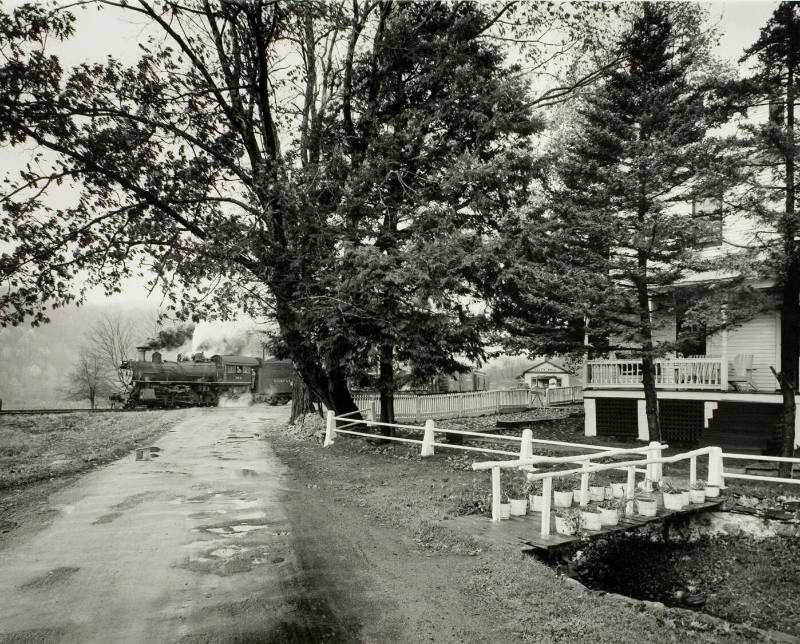
The Buchanan House with the Creeper in the background.
Photo used with permission of the Chrysler Museum, Norfolk.
Old Hully
My grandmother called the train "Old Hully" — she spelled it out for me as H-U-L-L-E-Y. She would stop working in the fields whenever she heard that whistle blow about a mile down the track, and call out to us: "Here comes Old Hully." The train ran so precisely that the whistle was a time signal for the whole community.
The Flood of 1977 and the Flood of the 1940s
The 1977 Damascus flood is nearly undocumented. There's one photograph and that's about all there is. A separate flood in the 1940s on Horse Creek, running from Damascus down to Lansing, washed out much of the railroad bed and is similarly undocumented.
The Woman in Labor
In the 1940s during a severe snowstorm, a woman from the Hiltons area — below Whitetop, toward Mount Rogers — went into labor. She was sledded up the mountain to Whitetop station. The train was helped up the grade and she was transported to Abingdon Hospital.
Straight Branch Road and the Native Trout
I overheard a story at Bristol Mall from an older man who remembered Straight Branch before the road was put in — sometime in the 1930s or 1940s. Before the road, the creek had strong native trout populations. Once the road opened it up, they were quickly overfished. I was skeptical. I went and researched it. The man was right.
Harley
A young man named Harley was around ten or eleven when this happened. He was hoboing on Train No. 12 with two or three other boys near the No. 12 trestle (46) above Whitetop. He slipped and went under the train and lost his leg. He survived, left the Whitetop area, came back eventually, and worked alongside me for thirteen years. He is now deceased, but in his adulthood he was one of the most intelligent men I ever knew. He also had a great sense of humor. One day Jamie was watching Harley work when Harley picked up a hammer and knocked it against his own leg. Jamie had no idea Harley had a prosthetic - Harley had never mentioned it. Jamie's reaction was complete shock. Also when Jamie was only 15 he had his own truck and Harley borrowed it one day. I really enjoyed seeing how anxious Jamie was even though I knew Harley would not damage the truck. Harley After leaving Whitetop following his injury, Harley had a series of travels and experiences he later shared with me. I called these "the chippers." (An anecdote or two here will be good.)
The People from Carolina Who Walked to the Store
In the 1950s, people from North Carolina would walk the old railroad grade up to the store at Whitetop to do their shopping. The rail bed was the practical path before the roads were established.
Compiled by Janice Thayer and Richard Smith for www.vacreepertrail.us
and the Historical Society of Washington County • April 2026